Sunday, 24 February 2008

...Statistics on Women...


WOMEN ARE NOT PASSIVE


Education

On the whole girls continue to outperform boys at all levels of education in the UK from Key Stage 1 to higher education. In 2005/06, 64 per cent of girls in their last year of compulsory education achieved five or more GCSE grades A* to C, compared with 54 per cent of boys. This was an increase for both sexes since 2004/05, when the figures were 62 per cent and 52 per cent for girls and boys respectively.

The difference in achievement between the sexes starts at an early age. In England, for Key Stage 1 (5 to 7 years old) to Key Stage 3 (11 to 14 years old), girls scored consistently higher than boys in the summer 2007. There was an exception at level 4 in Key Stage 2 (7 to 11 years old) mathematics tests, where boys (78 per cent) outperformed girls (76 per cent); and mathematics teacher assessments, where boys and girls both achieved 78 per cent. At Key Stage 3, the difference between the sexes was greater for English than mathematics, with 80 per cent of girls having achieved level five or above compared to 67 per cent of boys.


The increase in the proportion of both young men and young women in the UK gaining two or more GCE A levels (or equivalent) has been more marked among young women. Between 1990/91 and 2003/04, the proportion of young women gaining this result more than doubled, from 20 per cent to 44 per cent. In 2005/06 the figure was 42 per cent. Over the same period, the proportion of young men gaining this result increased from 18 per cent to 33 per cent.


At A level, in England, Wales and Northern Ireland, young women continued to outperform young men in virtually all subject groups in 2005/06. With the exception of French, German and Spanish, a greater proportion of women than men achieved grades A to C. In English both sexes achieved approximately equal proportions of A to C grades.


In 2005/06 more women than men in the UK were awarded National Vocational Qualifications (NVQ) and Scottish Vocational Qualifications (SVQ). This was most noticeable at level 3 where 63 per cent of NVQs/SVQs were awarded to women. Of over 600,000 NVQs/SVQs awarded, 56 per cent were to women compared with 44 per cent to men – unchanged since 2004/05.


The subjects selected for vocational qualifications differ between men and women. Men are more likely to study vocational qualifications for construction, planning and the built environment (with almost 100 per cent of these awards going to men), or engineering and manufacturing technologies (89 per cent of all awards), whereas women are more likely to study health, public services and care related vocational qualifications (around 86 per cent of all awards).

Latest figures from the Universities and Colleges Admissions Service (UCAS) show that there are more women than men entering full-time undergraduate courses: in autumn 2006, a total of 390,000 gained a place, of whom 210,000 (54 per cent) were women. Among those awarded degrees, men and women were equally likely to gain a first class degree, with a narrowing of the male/female gap; 11.5 per cent of men and 10.7 per cent of women gained first class degrees in 2005/06 compared with 11.1 per cent and 10.2 per cent respectively in 2004/05. However, the proportion of women attaining an upper second remained greater than that of men at 47 per cent of women, compared with 39 per cent of men.


Here are some Graphs-


WOMEN ARE PASSIVE


WORK WAGES/SALARY


The numbers of jobs paying at levels below the national minimum wage threshold (NMW) appear to be very responsive to the initial and uprated threshold levels, although the surveys indicate some evidence of a delay in the response.

Part-time jobs are about five times more likely to be low paid as full-time jobs, while women’s jobs are three times as likely to be low paid as men’s. The latter is partly explained by the fact that many more part-time jobs are held by women than by men; nevertheless a full-time job held by a woman is about twice as likely to be low paid as one held by a man.


SOURCE: NATIONAL STATISTICS GOV SITE (UK)
BY HAMMAD AND HASNAA
The Quran & Adverts.
4:34 "Men have authority over women because Allah has made the onesuperior to the other. Good women are obedient."

This quote shows how men have over powering women through not only adverts but through a patriarchal society. Adverts through adverts women are shown as the female sex symbol where for instance in the vodka advert where the women is laying under the man makes it seem, as if she is waiting upon the man or as the man is on top it may also further co notate that the man is over powering her. Hence, this may also show that as he is holding 2 glasses and vodka bottle this creates a fallacy of a penis hence creating ‘penis envy’ as stated a famous theorist. Men have always been superior to women because men are known to be the breadwinner and the highest earner moreover, reason being that they are meant to be seen as superior and women are meant to obey.

2:228 "Men have a status above women."
Men have more status over women because as stated above they are the highest earner. There is a glass ceiling effect which doesn’t allow women to go any higher then men within the work force- hence this is a downside for women. Women are only seen to be a housewife or the child barer. Turn on the TV I am inundated with images of how I, as a woman, should be? The most disturbing one for me today was a L’Oreal ad for a product that is supposed to fill in fine lines and wrinkles with silicone. The lovely Claudia Schiffer stars. After “applying” the product to her eye area, a young blond boy-child comes running into the room. She says, “My lines are filled, and my life is fulfilled!” and embraces the boy. There’s a double-whammy of a message: be pretty, and have babies.

There are the millions of cleaning supply ads featuring women scrubbing and spraying and sweeping and dusting and laundering. And the baby ads featuring women changing diapers and feeding babies and bathing babies. And the ads for food products, featuring women cooking and baking and icing cakes and pouring juice. And, the diet ads, featuring women who are newly thin prancing in bikinis and miniskirts. And the cosmetic ads featuring perfect skin and eyelashes and plump lips. Even the ads hoping to sell products to men tell women how they should be - and consequently, how men should want and expect women to be. The message here for women is, if you aren’t this way, men won’t like you.

Women wear makeup, dress more lavishly, it should be pretty clear that the male dominated society has reduced female power in other areas- so women use their sexuality - and enhance it by clothes, makeup, etc… there is a saying where women go to college for an ‘Mrs. Degree’ men of course, in a patriarchy, show their power by cars, etc. symbols of wealth.

Some feminists have subverted the use of makeup for their own purposes, and a few men wear makeup for example ‘Prince’, , little Richard, Billie Joe Armstrong and I personally think it’s naive to see makeup as anything but transforming women to fit the traditional view of women.

What I do feel is an issue is the impossible views of women that are put forth in the media via the use of lighting, computer technology, and over-made-up women. Women viewing these outlets begin to believe that that is what real women look like, when in fact it is all a farce. We then begin to compare ourselves to these unattainable standards, increasing our need for make up, diet pills and fads, miracle creams and the like.

Makeup has been used mostly to create illusions, by women to entice men by making themselves appear younger, healthy, more fertile, and flushed as though from a fresh romp in the sack. The underlying message is indeed, “you are not good the way you are.”

On the other hand, as something of a post-structuralist/post-modernist, I believe that identity categories are created by society. So I am a woman not because I have a vagina and ovaries and fallopian tubes and a uterus and breasts - I am a woman because society assigns me that role based on my physiology, and woman means many things completely unrelated to that physiology. And so, I understand the desire to recreate one’s identity through body modification of varying degrees. Body modification is not the issue. The reasons for body boob job or wear a pair of beautiful high heel shoes, and they still want to do those things, all the while understanding that it is marking them with physical evidence of being a woman in a patriarchal society. Reevaluate yourself and your motives from time to time.

I suppose one could choose to interpret the message of that commercial to say that a woman needs children to be fulfilled. Another way to interpret it is that Claudia Schiffer feels fulfilled by motherhood. A third way to interpret it is modification are at issue. And so, I feel that if women do the work of examining deeply why it is they want to, say, wear makeup or get a that “fulfilled” was a play on the word “filled” and was just meant to be a clever tag line.

A culture where women are expected to conform to ideal of femininity. However, I do see that this plays a role in my own self-expression and not a purely negative one. For me, make-up is a means to overcome what I call the terror of natural beauty. Because the male ideal is not a woman with good make-up but perfect natural looks.

The Bible and James Bond
11:10 "Women are under man's authority."

After the viewer sees Bond kissing Miss Trench the scene fades out and the audience knows that he will have sex with her before he leaves to fulfill his obligation of going to search for Dr. No. The scene does not show Bond saying goodbye to Trench, it simply cuts to Bond’s travels. Tara Brabazon comments on the process that is undergone as a woman is seduced by Bond and states: “The James Bond films…depict women enjoying rape, especially since Bond is the ‘good guy’ and the supposed fantasy of every woman. Once raped they are then ignored by the male star.”


14:34 "Women are subordinate to men."
Moneypenny embodies all of the characteristics that a housewife would have, and this is a threat to Bond because she represents settling down, having a family, and most importantly, giving up a life of promiscuity and self fulfilment. While Miss Moneypenny remains to be the only consistent Bond girl, appearing in almost every film, she is the only girl who is never targeted as a means to an end or used for sexual gratification. “Moneypenny’s office is encased not only by the proverbial glass ceiling, but also glass walls. She can view power, but wields little. Moneypenny remains the woman behind the man.

There is much potential, both politically and theoretically, in monitoring the confluences of feminism and popular culture. While much attention has been granted to Madonna and the Spice Girls, there are textual sites that have a far longer, and more complex, history. This article analyses Miss Moneypenny, a character in the long-running James Bond series. Through monitoring the super spy’s super secretary, we discover the contradictory, ambivalent, and surprising impact of feminism on this small but resonant site in filmic history.

While the women’s movement began to take shape Dr. No was being filmed and released in theatres. It is no coincidence that this film, which uses women as objects throughout the plot, is released during a time when women are fighting for equality in society. This film serves as a slap in the face to women, giving them a glimpse into the lives of the women with agency in the film and exactly what becomes of them due to their attempt to take power from Bond.

The article “Figures of Bond,” by Tony Bennett and Janet Woollacott, depicts the women in the Bond films as possessing a new sexual freedom. They state, “In sum, the ‘bond girl’ of the 1960s disconnected female sexuality from traditional female gender identities, preserving these latter virtually intact…” What helps Bond to disguise himself as a harmless male character in literature and film. By stating that female gender identities remain intact throughout the film is absurd. The only reason that any of the female characters in the film end up in the stereotypical female gender identities is because Bond, due to his insecurity and castration anxiety, places them back into this role to strip them of their agency and power.

From Russia With Love
The presence of women in the film seems to fall into two categories: the asexual prude and the slut. Klebb arguably embodies the former category. As the Russian matriarch who helps plan Bond’s entrapment, she is the most villainous woman in the film and is effectively depicted as a short, sexually ambiguous character who appears to be both stern and frustrated. As such, she carries some agency. Within the context of the Cold War, we may see her character as representative of a Communist ideal of equality between the sexes. She also happens to be portrayed as sexual deviant. Vito Russo, in his book entitled The Celluloid Closet: Homosexuality in the Movies, offers us this character assessment of Klebb:

In “From Russia With Love” ... Cartoon dykes are alternately killed in the grand tradition of heterosexual solutions ... In the former … Rosa Klebb, is old, snakelike, dangerous; a killer spy who makes cobra eyes at a young blonde agent on whom she tries to put the arm during a private interview.

Diamonds are forever
In “Diamonds Are Forever,” released in 1971, the perpetuation of the patriarchal socio-political structure is kept alive by the ultimate patriarch himself, James Bond. As in all other James Bond films he embodies all things stereotypically masculine and is successful in gaining control over that which is inferior or potentially threatening to his particular white heterosexual male status, particularly homosexuals, women, and people of other ethnicities, thus proving that he is representative of the dominant power. Throughout this film there is a definite “othering” of homosexuals, women, and those who are not white. But in addition to being sloughed off as “other,” these minority groups are also heavily defamed, especially in the case of the homosexual characters.

Of course, James Bond is the obvious subject here, once again upholding white heterosexual patriarchy. As such, there is a particular dilemma caused by the presence of Wint and Kidd. Being overtly homosexual, unlike previous villains who were ambiguous if anything, the duos are an antithesis of what Bond represents. However, by virtue of being men (especially in that both he and the two men are striving to secure control over their environments and situations), he is suddenly conflicted as he must confront his commonalities with them. Bond's realization of these similarities is, in fact, identification with the abject."That subject, weary of fruitless attempts to identify with something on the outside, finds the impossible within; when it finds that the impossible constitutes its very being, that it is none other than abject." The film's equation of Bond with all that is good, lawful, and masculine aligns Wint and Kidd with abjection. They reject patriarchal order, twisting its laws to their advantage without ever fully accepting or obeying them in the ways in which they were meant to be followed.

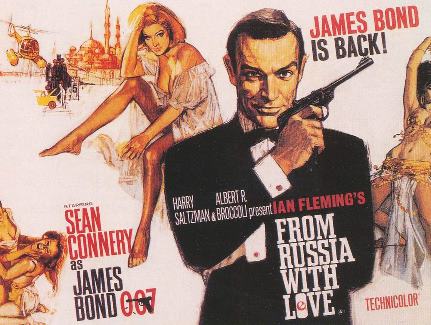
The Bond girl in the Dr No DVD cover conforms to the Mulvey theory of being an object of the male gaze and furthermore hold to quality of ‘to-be-looked-at-ness’. Furthermore, Bond being the protagonist reinforces patriarchy this also shown by the way that Bond is always holding a gun on the DVD cover.

The audience for the Bond films can vary, the target audience can been seen as males aged between 15 to 25 years old. A secondary audience can be identified as an older generation who enjoy watching the James Bond films since they began in 1962. Through the DVD cover women are not targeted however, the storylines try to engage women as they often show Bond having relationships with women.

The Bond films are well known to reinforce patriarchy values and undermine women. Casino Royal subverts the undermining of women the silhouette of the women figure is bigger than Bond, however, with his gun in his hand as a phallic symbol and the expression on his face he is conveyed to be more power and thus reinforces patriarchy. The Dr No DVD cover shows the female as a object and is present for the male gaze, this by itself reinforces patriarchy. Again Bond is shown to be holding a gun as a phallic object, giving him more power than the female.

Both covers show Bond in the foreground and a female in the background, this can convey a narrative of Bond having to overcome his promiscuous nature to save the world one more time. It also shows that the character of Bond does not see women as important thus also reinforcing patriarchy.

In conclusion, the Bond DVD covers convey patriarchy ideologies and values. Bond is shown to be the most important person on the cover, often in the foreground and holding a gun as a phallic object to reinforce his patriarchal status. The females are objectified and in the Dr No cover the female is wearing a bikini however, the most recent DVD cover only shows a silhouette of a female. Finally, these representations and ideologies conveyed through the DVD covers appeal to the male audience who are so fond of the action films with girls and fast cars.

BY HAMMAD AND HASNAA
The Marlboro Man, that icon of the rugged, solitary male, is meant to suggest that men who smoke Marlboro cigarettes are equally rugged and masculine. With the cowboy icon comes many other (often stereotypical) associations of strength, bravery and 'noble violence' — the lone cowboy using violent behaviour to protect the weak and defenceless (who are usually female).

Although The Captain was here is meant to be a humorous ad, there are disturbing aspects to it. The icon of 'the pirate' is associated with many negative forms of behaviour, and Captain Morgan's leering expression is anything but noble. The words "The Captain was here" written over the model's body, as well as the moustache and beard, support the attitude that women are sexualized objects, to be owned by men.
Hasnaa
EXAMPLES OF WOMEN WHO ARE NOT SEEN AS PASSIVE:
Kill Bill:
Tarantino describes Kill Bill as 'feminist settlement' which is 'all about girl power'.
All of the main characters, apart from Bill, are women.
She is not objectified by wearing revealing outfits, instead she wears an 'all in one' suit which covers up the whole of her body (similar to one Bruce-Lee wore in his last film).
She is seen as powerful and strong as she takes part in many fights, (martial arts-swords) which in the past was usually a male's role, like Pulp Fiction.


Tomb Raider:
Main charcter is female.
She is shown fighting most of the time, which again is usually a role which men are seen doing.
Lara appears to have a dominant relationship over another archaeologist, Alex. This dominant female/submissive male contradicts Mulvey's theory of the male as attractive/female passive.


Sex and The City:
Four powerful women who work and are single. This contradicts older programmes which portray women as not being independent without men and do not have jobs (housewives).
Have successful careers; published author, public relations, art dealer and lawyer.


Bend it Like Beckham:
'True girl power'.
Wants to become a footballer (a sport which is dominantly played by men) as opposed to learning how to cook (subverting the role of a stereotypical woman).
Kirandeep

Sunday, 17 February 2008

POINTS 4 DEBATE

WOMEN ARE NOT PASSIVE


Kirandeep- You should look at Spice Girls, when they came? did it grow/create 'girl power'? Were they role models for women? What were their connotations? They showed they were active, how? What else did they do apart from singing- Charity, soical work???
Hammad's Feedback

POINTS 4 DEBATE

WOMEN ARE PASSIVE

roles 4 the week

ok i've had a look at some of the stuff thats been put up on the blog and i think some of it is actually not relevent, so make sure all the research you've posted up:
  • is relevent to the media and not just about women being passive in genreal
  • not copied coz we have 2 explain the points in the debate
  • is properly explained
  • DON'T put the website link up and jus leave it without any explaination of what the hell it is because it really doesn't mean much without you explaining it!

Roles 4 the week:

Hammad- using all the research you have done, you need to post up 2 points which demonstrate that women are passive. These points need to be backed up with theorist, statistics etc .

Jaspreet- using all the research you have done, you need to post up 2 points which show that women are not passive. These points need to be backed up with theorist etc.

Tanya- Using all the reseach you have done so far, you need to post up 2 points which shows that women are not passive . These points need to be backed up with theorist etc.

Hasnaa-Using all the reseach you have done so far, you need to post up 2 points which shows that women are passive . These points need to be backed up with theorist etc.

Dipz- Using all the reseach you have done so far, you need to post up 2 points which shows that women are not passive . These points need to be backed up with theorist etc.

kiran- Using all the reseach you have done so far, you need to post up 2 points which shows that women are passive . These points need to be backed up with theorist etc.

Jasmit- Using all the reseach you have done so far, you need to post up 2 points which shows that women are passive . These points need to be backed up with theorist etc.

THIS NEEDS TO BE DONE OVER THE HOLIDAYS FOR MONDAY SO WE CAN START TO PUT OUR IDEAS TOGETHER ON MONDAY!

make sure you guys get this done or we will lose the debate because these points that you do will be used to form an answer. In you points try to critise the other side (e.g. if you are doing women are passive then try to critize the other side which is women are not passive) . Make comparisions with historical text, use theorist, make sure you make this work very clear, concise and relevent to media!

Post this all up under points for debate under the heading passive or not passive (depending on what your doing). Make sure you put your name at the end of your work so i no whos done what and if someone has already done a point, them you need to think of a different one, make sure your points are not the same as anyone else!

Thursday, 14 February 2008

blog adverts


Women's political action 7/23/97

REGION UNDER PRESSURE TO REVIEW DISCRIMINATORY LAWS by Grace Kwinjeh
Women in southern Africa are increasingly pressing governments to review laws which discriminate against them.
In Botswana the Unity Dow case, where women fought against the Citizenship Act which denied Botswana citizenship to children born of Batswana women and foreign husbands, set a precedent in the region for women to fight against other discriminatory laws. The government of Botswana, giving in to pressure from women's groups, has launched an official review of all the laws that affect them. Most pressure has been coming from women's organisations such as Emang Basadi, Women and Law in Southern Africa, Research Trust (WLSA) and other women's groups.
The women are currently lobbying for change in the law on marriage which they say treats them like children.
"When a woman marries, according to Botswana laws, she loses the capacity to make final decisions affecting the home. The law says the head of the family is the man. It says the husband is the legal guardian of the children," complains Athalia Molokomme director of Emang Basadi.
Other laws they want changed are, the Affiliation Proceedings Act, customary inheritance laws and The Deeds Registration Act. Laws which were not gender neutral now amended are, the Mines and Quarries Act, The Employment Act, and the Deeds Registry Act.
In Zimbabwe women are also lobbying for change in marriage laws. One of the aims of this long term process of law review is to see the extent to which laws can be reformed.
"We want to see what people say about marriage laws, for instance, where lobola is not a requirement, we want to know what people think," says Sheila Kanyangarara, co-ordinator of the Zimbabwe Women Lawyers Association (ZWLA), the organisation which is spearheading advocacy on the amending of laws.
Kanyangarara also said that when government passed the legal Age of Majority Act in 1982, there was not enough consultation and therefore not everyone was satisfied.
"We do not want to seem to be imposing our views on people, this is why we want to engage in discussions and debate, at all levels of society, with men and women," Sheila said.
Some laws might also look fair on paper yet they give different rights to people. In this case discrimination is not only sexual but can be based on race or class.
In SADC countries family laws need to be reviewed because they only worsen women's status. Under customary law in most, if not all countries, a woman is a minor and her rights are completely oppressed.
Molokomme however, says they have a long way to go, and that family law in Botswana reflects socio-cultural attitudes which subordinate women.
Women are also examining customary inheritance laws which entitle the eldest son to claim the family estate.
In Zimbabwe, it is hoped that changes to the Deceased Estates Administration Act, will in turn positively affect other laws which discriminate against women.
The department of labour in South Africa has begun a legislative reform programme to improve women's position in hiring, dismissal, training, remuneration and equal pay for equal work.
This legislative reform will include looking at the Employment and Occupational Equity Act aimed at removing discrimination against women at the workplace.
It is difficult to change the low status of women in society when on paper they are still discriminated against, so it is through the improvement of statutes that improvement in women's lives can be achieved.(SARDC)
WOMEN INTENSIFY EFFORTS TO GAIN POLITICAL POWER by Barbara Lopi and Grace Kwinjeh
A project that seeks to increase the number of women in politics and decision making in cabinet, local government, parastatals, non-governmental organisations (NGOs) as well as in the churches has been launched in Zimbabwe.
The two-year-project, launched by the Ministry of National Affairs, Employment Creation and Cooperatives (MNAECC) last month, shows the country's efforts to address one of the Beijing 12 critical areas of concern - inequality between men and women in power sharing and decision making at all levels.
The United Nations Development Programme (UNDP) in Zimbabwe is funding the project. Improving the representation of women at all levels of decision making is one of Zimbabwe's national priority areas of concern from the global Platform For Action (PFA).
The global PFA constitutes, issues that were identified as the main obstacles to the advancement of women. These are poverty, education, health, violence, armed conflicts, economic structures, human rights, media, environment, and the girl child, apart from power sharing and decision making.
Tendayi Bare, the senior secretary for National Affairs, Employment Creation and Cooperatives urged Zimbabwean women to have confidence and take up decision making positions in the public sphere. "If we manage homes, fields and families, why then can we not manage towns and countries?" asked Bare. In some countries in the region, women caucuses, coalitions and trust funds that go beyond the boundaries of party politics, are being formed to provide solidarity and financial assistance to female candidates for general and local government elections.
Women in the region believe their caucuses provide solidarity, cooperation and a possible solution to political divisions that hinder the struggle for equal participation with men in decision making.
In South Africa, for instance, women were drawn together prior to the first democratic elections in 1994 by the Women's National Coalition and drafted the Women's Charter for effective equality. This activity preceded the elections and produced an interim constitution which committed itself to equality.
Today, South Africa has a 33 percent quota of women parliamentarians and holds the distinction of being one of the seven countries in the world with the highest numbers of female members of parliament.
In Botswana, a national Caucus for Women Councillors and Parliamentarians has been established to encourage women to take up council and parliamentary positions.
This caucus affords women decision makers a forum to discuss and strategise on the best way to handle issues affecting women in Botswana.
In Mauritius, NGOs through the women's coalition are sensitizing women at grassroots on gender and participation in leadership positions.
In Mozambique, where women account for a 25 percent in decision making representation at national level, an NGO, Association of the Mozambican Women for Peace (AMWP) is battling to improve on this in all areas. Membership to AMWP is open to all women regardless of party affiliation.
The AMWP is currently preparing for an increased participation of women in local government elections to be held this November. It also wants to be active in the legislative elections that will be held in 1999.
In Zambia, a trust fund has been established to support financially female candidates contesting parliamentary and local government elections.
At the launch of the campaign support fund committee in Lusaka in May, the chairperson of the women's committee of the ruling Movement for Multi-party Democracy (MMD), Princess Nakatindi Wina urged women to unite and support each other.
Princess Nakatindi who donated one million Kwacha (US$900) to the fund said: "The fight for proper presentation of women on local government bodies goes deeper than a gender issue and touches on a problem which seems to be creating the last obstacle to complete national building."
The launch of the campaign trust fund will help lessen financial problems which is one of the main obstacles to women's participation in decision making positions in politics in the region.
The need for more women representation in decision making bodies will help governments in the region achieve transparency and accountability, which are key to true democracy. (SARDC)


Increasing Women's Representation in France and India

The immediate post–Second World War period saw women gain equal political rights in a number of countries, including France and India. Political participation researchers began to consider women's involvement in politics. However, because they focused on state institutions and political parties as the most important sites of political participation, and because the presence of women within these sites was insignificant, the conclusions drawn were either that women were uninterested in and/or uninformed about politics or that their interest and knowledge derived from the male head of household. Moreover, when women's political participation was considered, the preferred location of study was the Western liberal democratic nation–state (Dogan, 1955; Duverger, 1955).

Wednesday, 13 February 2008

...Women being Passive...

JAMES BOND SERIES

the female being object of the 'male gaze'

Women presented being clingy, however man in front.

http://www.megaessays.com/essay_search/structure_female_subordination.html
Skyy vodka advertisement. The ads purpose is to sell the company’s alcoholic beverage using the help of a woman in the image. The advertisement shows the woman in a negative connotation. There is a man in a suit standing directly over a woman in a swimsuit that appears to be tanning. It can be assumed that the woman is unbothered by the presence of the domineering man. This shows how it’s supposed to be ok for a woman to be the subordinate to the man. The man is holding a bottle of Skyy in one hand and two glasses in the other. It looks as though he is clenching the objects in his hand and it can be inferred that the woman below him has no choice but to have drinks with him. This shows dominance as being sexy, and that women have no authority over the men. In terms of the woman she is thin with full breasts, and presents the idea that women should live up to this standard to be attractive to men. The lighting in the picture is very exploitive and further demoralizes the woman. The framing of the picture shows the crotch area as being directly over the face of the woman and it is highlighted to accentuate that area. The woman’s breasts are also lighted in the way to draw the reader’s eye to that area. The product in this ad becomes secondary because the reader will be attracted to the breasts and crotch, and then realize that is an ad for Skyy. The clothing in the ad shows the man as having economic status with further pushes the idea that the more money the man has the more inferior the woman has to be. Her lack of clothing shows her as an object to the man and that is why he has chosen her to have drinks with him.
http://answers.yahoo.com/question/index?qid=20080211180931AAh59gD


Superiority and Domination- In advertising and other media, women are sometimes portrayed in poses that physically subordinate them to men. Men are often shown in a dominant position and in control of the situation being portrayed.

..Women are subordinate to Man...

Forms of Male Domination and Female Subordination
Men in Feminism
• Higher Education
• Political Involvement
• Social Status
• Economic Sphere
• Sources

Fear; that is driving force behind many of the ills patriarchal society has placed upon women. Fear of women thinking on their own, growing strong in government, transforming the home, and being financially independent has made men throughout history cower to the women's movement. However, there are those few brave men who have stepped out of line with their fearful comrades to voice what was right, giving women their due. Those few supporters have transformed contemporary male thought to yield to women's efforts for higher education, social responsibility, political freedom, and economic independence.
It is important to view the male perspectives of women because feminism often gets a bad rap for "male-bashing", when in fact, throughout the movements history, many of the biggest allies have been pro-feminist men. It is imperative that society understands the dogmas men have placed on the female sex and the rhetorical reasoning that some men used to help break women from that dogmatic bondage.
EDUCATION
Education was a major battleground for women to start their war. During the Victorian times, women began to assert their claim to higher education or any formal education at all. The main male concerns with allowing women to receive an education were that they thought learning would physically deform women, make their brains develop large while weakening their wombs, destroy their figure and complexion, and finally co-education would sexually stimulate the male students, in return, distracting them from their studies (Kimmel, 102).
Pro-feminist men countered these unfounded fears by arguing that education was the right of every woman. There were men like Matthew Vassar and Frederick Barnard who petitioned for women to receive higher education. They opened schools like Vassar, Barnard and Woman's College at Wesleyan to instruct young women. Barnard pointed out in his article that men were afraid to step outside of the box created by their fathers because "we have not the courage nor the independence to venture on a measure unsanctioned by their example or unapproved by their presumed wisdom" (Kimmel, 115). They thought educated women would make better mothers because they would be able to guide and teach their children in a more effective matter. These women would also add to social growth. With half the population denied a formal education, they wanted to point out all the lost opportunity of knowledge that could be cultivated from their unexploited minds. Their main line of argument with the anti-feminist qualms was that there was no sound academic or scientific research showing that women were physically less intelligent than. Victorian pro-feminist men maintained that in order for women to become equal, they must have opportunity for education.
The contemporary pro-feminist man is focusing more on male education nowadays. They hope to educate more and more men on the struggles of the female sex. They are also working in conjunction with women to incorporate more women's history into the curriculums of children's education. Men's studies is another big focus of the contemporary pro-feminist. In a 1990 article by Harry Brod, he claims that by using the tools learned in the feminist movement, a men's studies department would "expose and demystify the culture of male dominance from the inside out,... offering both women and subordinate men the empowerment such knowledge brings" (Kimmel, 396). They are hoping to educate everyone on the stereotypes of men and show man in a category of his own, with his own disadvantages and unfounded expectations.
POLITICAL
In Victorian times, the struggle between women's suffrage and abolition was tightly bound. Pro-feminist men and abolitionists like Frederick Douglass and William Lloyd Garrison were strong supporters of the women's movement. Douglass wrote "The Rights of Women" in 1848 and talked adamantly in favor of women's right to political freedom. After he attended the Women's Rights Convention in Seneca Falls, he was a changed man. He said, "a discussion of the rights of animals would be regarded with more complacency by many that are called wise and the good of our land, than would a discussion of the rights of women"(Kimmel, 211). He used sarcasm like many pro-feminist rhetorical writers of the time when dealing with the silly assumptions that men made about women's status.
Anti-feminist men maintained women were too pure to be thrown into the grimy game of politics. Once again, they were thought too feeble-minded and weak to handle the troubles of political involvement. George Francis Train and many other men however thought that women's purity could be the saving grace of politics. He said, "I am asked, would you drag women into the mire of politics? No sir. I would have them lift us out of it" (Kimmel, 203). Others argued voting would "unsex" women and make them more masculine. This was again countered by a popular poem of the time which declared that if women could work in factories, mines, and labor duteously in the home, and had not yet become "unsexed", why would the vote all of a sudden make her manly.
In contemporary times, the Equal Rights Amendment (ERA) has been in contentious debate since the 1923. Many lawmakers and lobbyists on both sides of the feminist fight have been battling it out in Congress. A California congressman, Don Edwards, had introduced the bill every year to the House. In 1989, he argued "women are entitled to their birthright to full rights of citizenship" and that the same old excuses of political equality "destroying women, the family and our country" no longer, and never, stood up (Kimmel, 432). Other men's organizations supporting women's political position have popped up. There is the Men Allied Nationally for the Equal Rights Amendment, the California Anti-Sexist Men's Political Caucus, and the National Organization for Men Against Sexism. Each of these groups tries to educate the public on women's conditions and what men can do by placing ads, holding marches, and demonstrating on behalf of the ERA.
SOCIAL
Women's social status throughout history was entirely attributed to the fear residing in the hearts of men. It was their fear that kept women in the home, under their father and husbands control, with no sexuality of their own. In The First Blast of the Trumpet Against the Monstrous Regiment of Women (1558), John Knox vilifies the position of women in society. He contorted The Bible's idea of marriage to claim women were subordinate to men in all realms of life. This thinking would continue into the Victorian times, and to some men still rings true. Jean Jacques Rousseau also belittles women in Sophy, or Woman. He says women "are not content to be pretty, they must be admired...It is not enough that a wife should be faithful; her husband, along with this friends and neighbors, must believe in her fidelity...she should have the witness not only of a good conscience, but a good reputation" (Bosmajian, 50-51).
Both Rousseau and Knox helped to feed the social inequalities that would plague women. The majority of society in Victorian times and many anti-feminists contended women's place was in the home as wife and mother. Women were to be seen and not heard. Pro-feminist men wanted more liberalized divorce laws, more equality in the home, and more birth control. Some promoted women's celibacy by arguing that without sex, men held no real power over women, and all defined sex roles could be obliterated. The other side of the spectrum claimed sexual freedom was the way to go because according to American Fourierist Albert Brisbane women would have the power and privilege to change partners if they became unsatisfied with their husbands (Kimmel, 284-85).
After he was arrested for helping his wife distribute birth control information, William Sanger was arrested in 1915. At his trial, he gave a statement defending women's right to birth control. He attributed thousands of preventable deaths to a lack of birth control information and called that "obscene and indecent", the charge he was being arraigned for (Kimmel, 351). But, marriage and family were just the tip of the iceberg concerning women's social inequalities. Marriage and sexuality became the biggest issues to tackle for the nineteenth-century pro-feminist man.
In contemporary times, pro-feminist men are focusing on women's right to control their own bodies and sexuality. They are forming organizations to combat against male violence and rape towards women. Many are also trying to make sweeping reforms in the home, with men taking more responsibility for the children and housework. They are trying to change the negative connotation that a stay-at-home dad receives, and society is becoming more accepting of this. All in all, contemporary pro-feminist men are trying to publicize the changing relationships between men in women in the last fifty years.
ECONOMIC
The economic sector was and still is one of the hardest spheres of society for women to break into. In a letter to his father, Robert Dale Owen claimed the anti-feminist man of the Victorian period thought that a working woman would "uproot the foundations of society, destroy the harmony of the domestic circle, invade the sanctity of the marriage relation, and a great deal more of the same nonsense" (Kimmel, 149). Women workers were thought of as stealing jobs away from capable men for lower wages, spending their earnings on "their frivolous consumerist appetites", and committing "race suicide". Even President Theodore Roosevelt thought a working women would aid in the decline of the Anglo-American race because immigrants were breeding at a higher rate (Kimmel, 153-55).
Pro-feminist men countered all these arguments well. They argued that men's inability to bring home a substantial wage was forcing these women to enter the workforce. They also abhorred the idea that women were doing the same work as their male co-workers for a significantly lower wage. In William Bowditch's article, How Long Shall We Rob and Enslave Women?, he argues that men and the government are stealing millions of dollars away from women by not paying them their fair share (Kimmel, 161). Others contended that equality at birth entitled women to equal wages. The battle waged on and still goes today.
In today's booming economic times, women are still earning seventy-eight cents to every man's dollar. Modern pro-feminist men are aiding in today's movement for pay and labor equity. They back women's right to "enter professions previously closed to them, to enjoy the protection of affirmative action and to enjoy union participation and leadership" (Kimmel, 369). In a speech to the Coalition of Labor Union Women, George Meany supported the ERA and one equal pay by saying, "If supporting a living wage for all workers makes me a feminist, move over sisters; I've been called a lot worse."
Throughout the last two centuries, men have been women's largest barricades to progress, but they have also aided the feminist movement in a magnificent way. Educational, political, social and economic reforms in women's favor have made milestone movements, but men and women are realizing that they still have a not won the feminist war. Until the underlying fear men hold towards women is dissolved, pro-feminist men must continue to fight alongside their sisters, wives, mothers and daughters to create a world were all are equal.
SOURCES
Bosmajian, Hamida and Haig. The Great Argument: The Rights of Women. Reading, Massachusetts: Addison Wesley Publishing Company, 1972.
Jardine, Alice and Smith, Paul. Men In Feminism. New York: Methuen, 1987.
Kimmel, Michael and Mosmiller, Thomas. Against the Tide: Pro-feminist Men in the United States, 1776-1990. Boston: Beacon Press, 1992.
Knox, John. The First Blast of the Trumpet Against the Monstrous egiment of Women. Amsterdam: Da Capo Press Inc., 1972.
This page was written by Nikita Pavoggi, and is maintained by Melanie Ulrich.
This page was last updated Saturday, 18-May-2002 08:28:11 CDT


"The Mandate of Heaven elects certain men (not women) to be rulers of the tribes."

The Bible
Genesis 3:16 "Your husband shall be your master."
I Corinthians 11:3 "The head of woman is man."
11:10 "Women are under man's authority."
14:34 "Women are subordinate to men."
14:35-36 "Wives must submit and obey."
Ephesians 5:22-24 "Wives must submit and obey."
Deuteronomy 22:20-21 "If no proof of the girl's virginity can be found,
she shall be stoned to death."
1 Timothy 2:11-14 and 1 Corinthians 14:34-35
"Let women learn in silence, with subjection and humility.
Never let women teach men or have authority over men.
Women must be silent in church meetings.
This is because Adam came first, then Eve, and it was Eve who
was first deceived by Satan, and sin was the result."
Numbers 31:14-18, 32-46
"Moses was angry with the army commanders who let women live. Women are the cause of plagues and sin. Moses commanded that all women who had experienced sexual intercourse be killed, but the soldiers could keep the virgins 'for their own use.' When the war booty was counted, the virgin girls were treated like sheep, oxen and donkeys. The young women were counted and used like animals, as the Lord directed."

The Quran
2:228 "Men have a status above women."
4:34 "Men have authority over women because Allah has made the one
superior to the other. Good women are obedient."
--------------
Elizabeth Cady Stanton 1815-1902 women's rights activist
"The whole tone of church teaching in regard to women is contemptuous and degrading.
Religions have opposed female freedom and taught inferiority and subjection;
these superstitions perpetuate bondage."
The male religious leaders realized they could eliminate half the leadership/power competition, if they could make this female degradation stick. Catholics, Mormons and Islamics have been very successful, for example.

BOOK RESEARCH

Greasers and Gringos: Latinos, Law, and the American Imagination By Steven Bender


By Hammad and Hassna

Monday, 11 February 2008

http://www.inter-disciplinary.net/ci/erotic/er3/Vandermassen%20paper.pdf chek this website out on Laura Mulvey ....... Jas
Roles for this week and over half term.. MAKE SURE YOU ALL DO THE WORK!

Hammad
  • Look for statistics (percentages etc) showing that women are passive for example in films, advertising.
  • Compare women in old films, advertisng etc to see how women are seen as passive. (Give examples)

Kirandeep

  • Look for statistics (percentages etc) showing that women are active for example in films, advertising.
  • Compare women in old films, advertising etc to see how women are seen as active.

Hasnaa

  • Print and put on the blog 4 examples of adverts/ film posters (print media) that show women as Active.
  • Also put these examples on the blog.

Dipps

  • Print and put on the blog 4 examples of adverts/film posters(print media)that show women as passive.
  • Also put these examples on the blog

Jasmit

  • Research theorists of women being active.
Gender in Advertising by David Gauntlett

Friedan’s (1963) critique of women’s magazines runs alongside a similar assessment of advertising; the stereotypes reproduced by the housewife’s journals were the same as those exploited by advertisers.

· Tuchman’s (1978) argument about ‘the symbolic annihilation’ of women is based on an analysis of advertising as well as other media.

· Gunter’s (1995) studies show that women in magazine adverts prior to the 1970’s were rarely shown to be in paid work, when they were the depicted a stereotypical role e.g. a smiling secretary.

· The number of ‘housewife’ images began to decline slowly after the 1950’s but were still common in the 60’s and 70’s.

· Advertisement’s in the 1970’s found evidence of stereotyping of all ads featuring women; three quarters were for kitchen and bathroom products.

· Gunter (1995) studies found strong similarities in gender representation from country to country, and particular sexism in adverts aimed at children.

· Mcdonald (1995) advertisers generally lagged behind women’s magazines in the cultivation of new modes of address, even when the evidence suggested that commercial advantages could be gained from modernising their approach.

· Mcdonald (1995) – believing both that feminism’s battles had been won, and that its ideology was now harmless by virtue of being out of date, advertisers invented ‘postfeminism’ as a utopia where women could do whatever they pleased, provided they had sufficient will and enthusiasm.

· Greer - Thirty years ago it was enough to look beautiful; now a woman has to have a tight, toned body. (ibid).

· Baudrillard states that only women are seducers, but empirical evidence suggests otherwise. Men too are seducers – a male version of the perfect provocateur. The ideal man in ads is young, handsome, clean-cut, perfect and sexually alluring.


Representations of gender today

· During the 1990’s and into the new century, gender roles on television became increasingly equal and non-stereotyped, although the majority of lead characters were still made.

· In 1992- 1993, men took 61 percent of the total number f speaking roles, women have the other 39 percent.· Studies show that small number of the major characters were female – just 18 percent.

· A significant decrease from the 1970’s; only 3 percent of women were represented as housewives as their main occupation.

· Women were free from family and work place pressures (Elasmar, Hasegawa and Brain, 1999:33).

· Some shows put successful professional women at the forefront, and are focused on their quests for sex, pleasures and romantic love, e.g. sex and the city.

· Buffy the vampire slayer; the character is more powerful and heroic, Buffy is more confident and assertive, depicting women in society.

· Representations of gender on TV have changed considerably within the past decades, today female and male characters are likely to be as intelligent, talented and resourceful, and there is equality.

· Nevertheless, many conventions of masculinity and femininity remain; men continue to dominate certain areas e.g. BBC’s coverage of the 2001 general election was led by authoritative, middle aged white male.

· Maggie Humm – Film... often anxiously envisions women stereotypically as ‘good’ mother or ‘bad’, hysterical careerists, (1997).

· There are many films that depict ‘girl power’ and female heroes, X-Men, The Matrix, Crouching Tiger, Hidden Dragon and Tomb Raider.


Gender and IdentityRepresentation Of Gender In The Past – Key pointsMen and Women on TV

· In the 1950’s, 60’s and 70’s, there were only 35 percent of female character roles on TV

· Mid 1980’s there was a substantial increase of women in leading roles; however there were twice as many men on screen.

· In 1975, Miles found out that comedy situations had equal proportions of men and women, although the gender roles and the humour could still be traditional and sexist.

· Furthermore, in 1987 a study found female characters to be most common in comedy programmes (43 percent).

· Despite these statistical parity – whereas in action adventure shows, only 15 percent of the leading character where women.

· A study by McNeil (1975) concluded that women’s movement had been largely ignored by television. With married housewives being the main female role portrayed.

· Further more studies in the 1970’s found that men to be the dominant characters and the decision makers on TV.

· Women were more likely to be passive; men were more likely to be adventurous, active and victorious, whereas women were more frequently portrayed as weak, ineffectual, victimised, supportive and laughable.


Women and Men in Movies

· In the 1950’s films “Angry Men” almost always focused on male heroes, men typically made the decisions which led the story and narrative, they were also assertive and dominant.

· However women had roles that were likely to depict them as frightened, in need of protection and direction.


· In the 70’s there was a backlash at the representation of women as Leia from Star Wars is depicted as a princess, top of the social hierarchy.

· 1990’s – Kathi Maio noted ‘strong, victorious women exist in film, just not often enough, and generally not in movies that get much play’. Susan Faludi went a step further by saying women were being ‘reduced to mute and incidental characters or banished altogether’, with particular reference to Predator (1987) and Lethal Weapon (1987).

by Jaspreet Hayer 13B YEAHHHH!

Thursday, 7 February 2008

Women : Subordinate

Role Models :

It is undeniable that the media shapes our conceptions of what it means to be male or female. We encounter many different male and female role models in the course of a day's media consumption. The issue is, that although these different role models may at first glance appear to be very varied, do they actually represent enough of a range of men/women? Are we simply given variations on a stereotype that become sub-stereotypes in themselves? By adopting role models and parading them through the media as people it is desirable to 'be', are we stunting individual growth?

Representations of Femininity

Feminism has been a recognised social philosophy for more than thirty years, and the changes that have occurred in women's roles in western society during that time have been nothing short of phenomenal.

Yet media representations of women remain worryingly constant. Does this reflect that the status of women has not really changed or that the male-dominated media does not want to accept it has changed?
Representations of women across all media tend to highlight the following:

  • beauty (within narrow conventions)
  • size/physique (again, within narrow conventions)
  • sexuality (as expressed by the above)
  • emotional (as opposed to intellectual) dealings
  • relationships (as opposed to independence/freedom)

Women are often represented as being part of a context (family, friends, colleagues) and working/thinking as part of a team. In drama, they tend to take the role of helper (Propp) or object, passive rather than active. Often their passivity extends to victimhood. Men are still represented as TV drama characters up to 3 times more frequently than women, and tend to be the predominant focus of news stories.
The representations of women that do make it onto page and screen do tend to be stereotypical, in terms of conforming to societal expectations, and characters who do not fit into the mould tend to be seen as dangerous and deviant.

pardeep